

AI can do more and more these days: writing, programming, analyzing, you name it. The question I keep coming back to is how much thinking to hand off to AI, along with the task. I wrote this post a few years ago, before AI was really part of the picture. But reading it back now, I think the core question is the same: when do you decide yourself, when do you bring others in, and when is it okay to hand something off entirely? It’s a question worth thinking about, whether you’re working with people or with AI.
This story goes back to the middle years of my design career, when I was still figuring out what it really meant to lead.
During a team meeting, my manager brought up a project plan he had asked me to draft. I had been busy and not started yet, and I definitely wasn’t expecting him to bring it up in front of everyone. My mind went blank for a second.
Then an idea came to me: the plan didn’t exist yet, and we were all sitting right there together. Why not turn it into a group brainstorm? We could collect ideas from the team, everyone would feel involved, and that’s good design thinking, right? I was pretty pleased with myself.
So I said I had actually been hoping to open this up for discussion, and invited everyone to share their thoughts. I took notes. It seemed to go fine.
After the meeting, as I was packing up to leave, my manager pulled me aside. “Got a few minutes? I want to talk about what just happened with the project plan.”
I assumed he wanted to add something. Instead, he got serious: “When that topic came up, everyone was expecting you to show some leadership. But that didn’t happen.”
I didn’t understand. I asked him to explain.
“I gave you ownership of this project. As the owner, you’re supposed to move it forward, and come up with an initial plan, something people can react to. When I asked about the progress, the team was expecting you to present your thinking so they could give you feedback. Instead, you turned it into a group discussion from a blank slate. It looked like you did not think about it yet and were hoping the group would do the thinking for you. So is this your project, or everyone’s project?”
My face went hot.
“I’ve been busy and haven’t had a chance to prepare anything. When you brought it up suddenly, I just thought since everyone’s here, why not brainstorm and get people engaged.”
He softened a little: “Not having started yet is completely fine. What I want you to understand better is what it means to lead a project, when to make the call yourself, and when to bring others in to decide together.”
Looking back now, my move was pretty naive. I genuinely thought I was being clever by turning an awkward moment into a collaborative one. But what I was actually doing was dodging ownership. That conversation was one of the moments that shifted how I understood leadership: it starts with showing up with your own thinking, even when it’s incomplete. It took time, but I think I eventually grew into that.
Later, in one of our regular one-on-ones, my manager walked me through four ways of making decisions: Command, Consult, Vote, and Consensus. The idea is that a thoughtful decision-maker picks the right approach for the situation, one that’s both efficient and fair.
These four approaches come from the book Crucial Conversations by Kerry Patterson, Joseph Grenny, Ron McMillan, and Al Switzler.
I found them so useful that I turned them into a sketchnote, mostly as a reminder to myself.
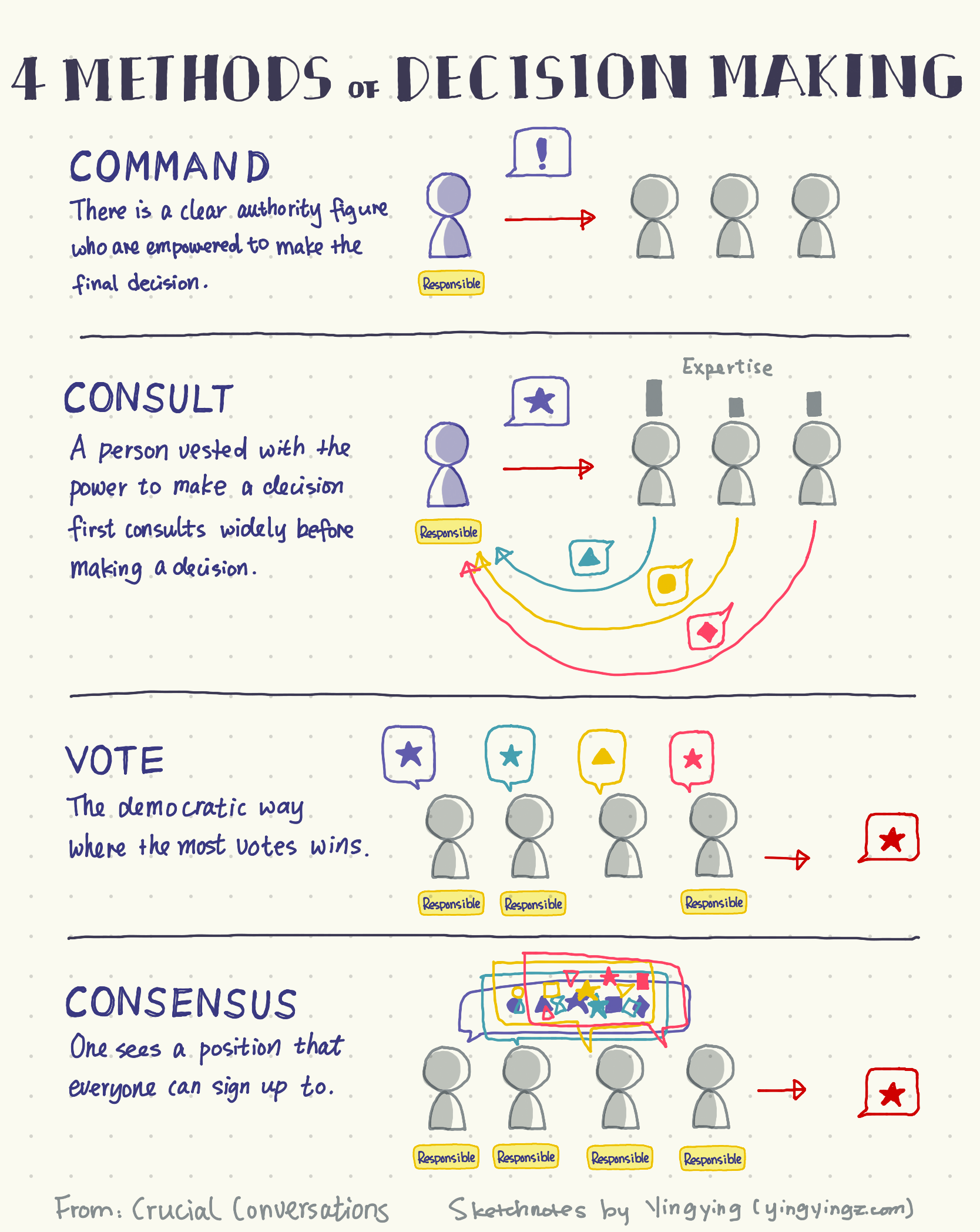
Command
This is when the decision is made by an outside force, either someone imposes it on us, or we hand the decision over to someone else and let them handle it. Our job here isn’t to decide; it’s to execute.
When we voluntarily give up the decision, it usually means we either don’t think it’s high-stakes enough to weigh in on, or we trust the other person to make a good call without us.
I grew up with a lot of Command moments: parents told me when and where to go to school, teachers told me how much homework to do. As I got older, more and more decisions became mine to make. And at work, how much say you have depends on your role.
As a UX designer, I make a lot of design decisions, and I rarely hand those over to others. But early in my career, at a small company, a senior leader looked at my design and said “it should be done this way.” I explained my reasoning. He said, “just do it my way.” I explained again. He got impatient: “Come on, help me change it,” and walked off. I felt completely deflated. He didn’t have a design background, and I had no choice but to follow the instruction.
If that happened today, I would know how to respond more effectively, and I would find other ways to validate my work.
Consult
The decision-maker gathers input before making a final call. It’s an effective way to get different perspectives and build support, without letting the process turn into a group decision. You listen, you weigh the options, you decide, and you communicate the outcome.
If you’re a designer, you probably already know this well. Many design teams hold regular critique sessions where each designer presents their work to be questioned and challenged: why did you design it this way? Why does the user have to click a button to do this? Why does this icon look like that?
The presenter brings the work. But they’re also the decision-maker. They choose what to show, what feedback to ask for, and what to do with what they hear.
Going back to the project plan story: that was exactly where I needed Consult. I should have drafted something first, even rough, then brought it to the relevant people for input, revised, gathered more feedback, and finalized. Instead, I skipped the first step entirely and hoped the group would do it for me. That’s not consulting. That’s passing the work off to the group.
Vote
A few options are on the table, everyone votes, the majority wins. It’s democratic. But does the majority always make the best call? Not necessarily. Voters might not all have deep knowledge of the problem, they can be influenced by all kinds of things, and if someone starts trying to persuade others to vote their way, the result can shift quickly.
That said, Vote is great when speed matters most, especially when there are a few solid options already laid out and you just need to pick one.
At work, I have mostly used it in design brainstorms to surface the most important themes, or to let the team vote on what to do for a team outing. Low-stakes, efficient, good enough.
Consensus
Everyone keeps discussing until they all genuinely agree. The upside: strong alignment and better decisions. The downside: it can take a long time, or end up with a result that nobody is really happy with.
Consensus is worth it when the stakes are high, the problem is complex, or when everyone needs to be fully on board with whatever gets decided.
As a designer, I use it constantly when working across teams: with product managers on design direction, with engineers on what’s actually feasible. I’ve learned to come into those meetings well-prepared, walk through things section by section, check in on questions along the way, and leave time for discussion. When it works, we leave aligned. When it doesn’t, I schedule a follow-up.
Once everyone has agreed, there’s no going back. If a consensus decision goes badly wrong, everyone shares the responsibility.
That’s also why I think it’s so important to speak up before consensus is reached. If I disagree with a direction but stay quiet, once the group agrees, that window closes. Bringing it up afterward looks like I knew all along but said nothing, then why didn’t I speak up earlier? My perspective might actually change the outcome. It’s worth saying out loud.
I still catch myself reaching for the wrong approach sometimes, like moving too fast when I should have consulted more people, or opening things up for discussion when really I just needed to make the call. But having these four options in mind has made me much more intentional. Before walking into any decision, it helps to pause for a second and ask: what kind of decision is this, really? The answer shapes everything: how I prepare, who I involve, and how much time we actually need.
Now, these four approaches feel more relevant than ever, because it also applies to how we work with AI. We started by using it as a tool, and now many of us collaborate with it daily. As AI becomes capable of thinking and acting on its own, what that relationship looks like is still being figured out by all of us. That's a choice we each get to make.
Hi Yingying, Thank you for the mental stimulus. Your posts are always great for this.
This one brings to mind these three sources and their perspectives which I value, too:
1) Richard Feynman Problem-Solving Algorithm:
a. Write down the problem (be as precise for your own mind's consideration as you are when composing an AI prompt)
b. Think real hard (yes, YOU do the thinking; don't outsource it to anyone or to any AI)
c. Write down the solution (only then, look for what's still missing where research or collaborative minds can help fill in the gaps in logic or reasoning);
2) Thoughts by British negotiator Simon Horton in his recent books on effective negotiating: Change Their Mind & The End of Conflict;
3) and Harvard Psychology Professor Ellen Langer's suggestion of, rather than over-investing in attempting to make the "right" decision, make an inspired/informed decision and then, once made, invest in making that decision "right." Ever appreciatively on-word in friendship, A.T.